7 Ways to Make Your Podcast Irresistibly Human in an AI Age
If podcast feeds fill up with AI-generated shows, the value of a real human host becomes even clearer. Listeners want a voice they can trust and a person they can follow. Here are seven ways to show them they are hearing one.


Inception Point AI CEO Jeanine Wright believes her tool proves automation can make podcasting profitable. Using AI-generated text read by AI-generated voices, Inception Point spends as little as possible to make as many episodes as possible. Then, Inception Point AI sells ad space on the podcasts.
Yes, anyone can try a similar exercise using ChatGPT and Descript. But, as Mark Francis illustrates, it’s unrealistic to make 3K episodes a week and turn a profit. You could also hit yourself over the head with a rolled-up newspaper three thousand times, and enjoy it as much.
What this exercise lacks is crucial: audiences. Who’s listening? Humans would probably prefer watching the rolled-up newspaper trick.
Here’s why your humanity matters more than software. In The Podcast Landscape survey, the Sounds Profitable team wanted to know why people listen to podcasts. They listed some of the benefits and asked how important each was to the survey participants. Of the benefits that respondents considered “very important” or “somewhat important,” companionship benefits ranked pretty darn high.
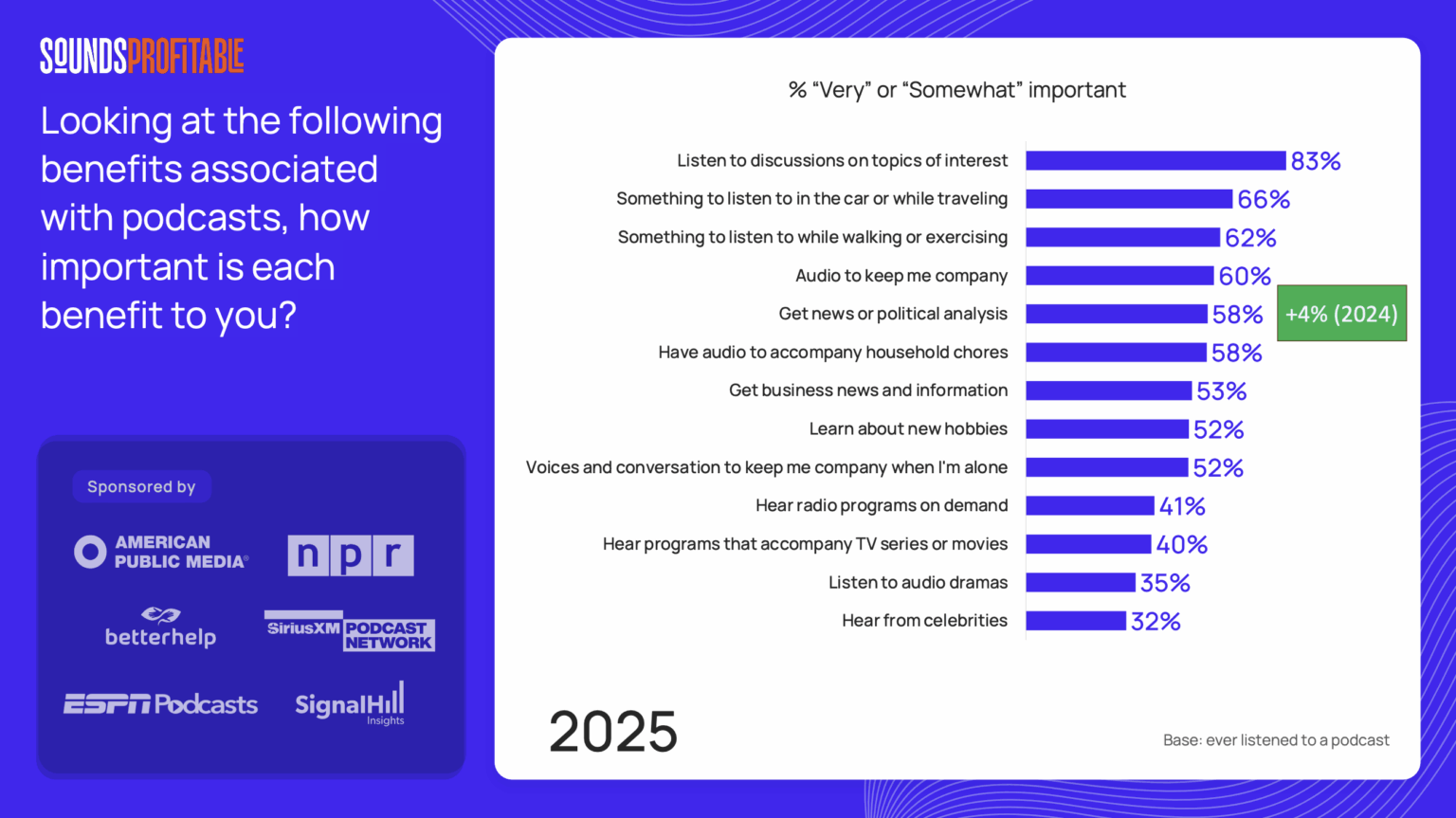
As shown above, over half of the respondents consistently value podcasts as companions for their activities, such as travel, exercise, or chores. I’d bet that “voices and conversation to keep me company when I’m alone” is a more vulnerable statement than most people would admit, but 52% of respondents proved me wrong.
Audiences aren't consuming podcasts solely for information. I’ve listened to podcasts as a research aid, but even when I needed “just the facts, ma’am,” what held my attention was the human voice and experience, with all their quirks, providing those facts in context.
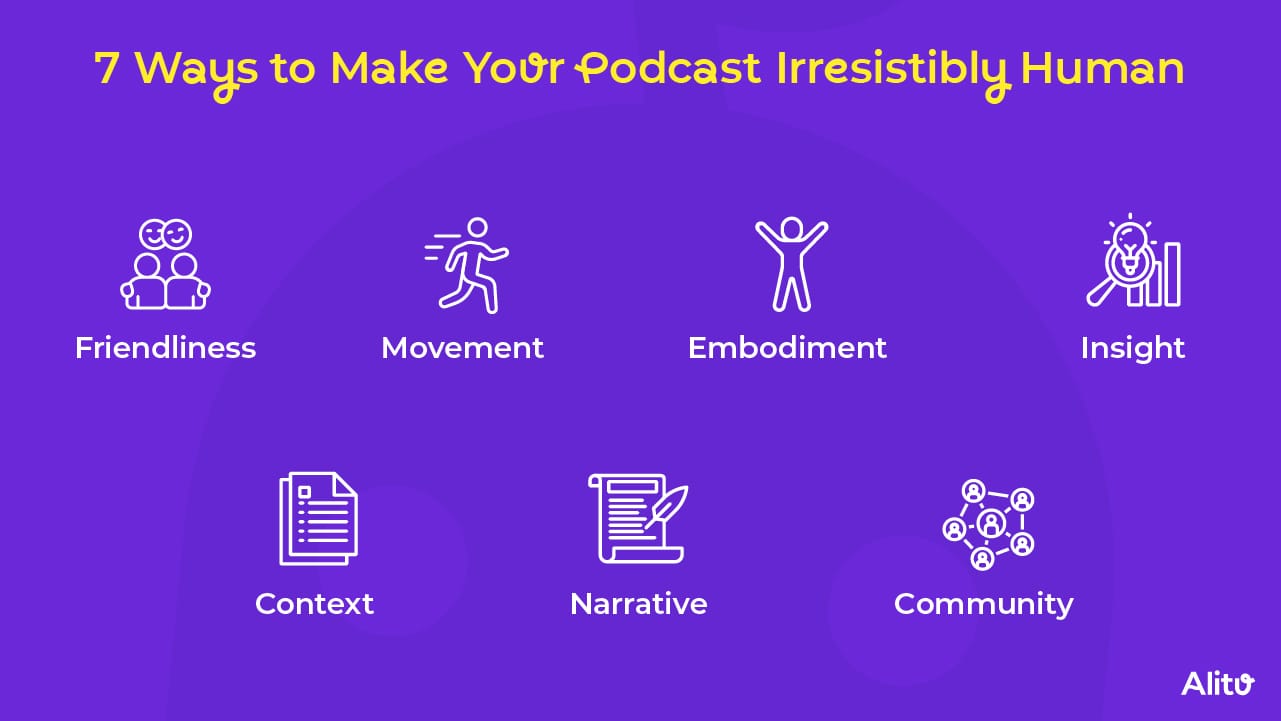
If podcast feeds fill up with AI-generated shows, the value of a real human host becomes even clearer. Listeners want a voice they can trust and a person they can follow. Here are seven ways to show them they are hearing one:
1. Keep It as Simple as Talking to a Friend.
Ever needed to send someone a message right away, and instead of typing a text, you hit the microphone icon and start talking? Not only are these voice notes efficient, they add personality, making them more affecting than letters on a screen. Your podcast can be as simple as a voice note from a friend.
Becky Pierson Davidson wanted to start a podcast to generate business leads. Podcasting journalism’s emphasis on video kept her from starting for two years. The added expense, tasks, and pressure didn’t feel worthwhile for what she hoped to accomplish.
But Becky and her friends shared a group chat where they discussed work snags and problem-solving strategies. Often, they’d use voice notes to support each other. She realized, “Some of my voice notes to my friends, there's some real gold in there… What if I just made these public?”
Before podcasting, she’d already been publishing a business-strategy newsletter and had asked her friends and followers for testimonials. “Almost every single person used the phrase, ‘I feel like I'm learning from my smart friend,” Becky said. “And so that's how I positioned the podcast. It’s like a quick voice note from your smart friend.”
By keeping it simple, Becky Pierson Davidson can publish her podcast consistently, and it becomes a beneficial habit for her audience. Most people would rather hear a quick voice note from a friend than anything else.
2. Record While Taking a Walk.
There’s something special about hearing someone podcast while they walk. It feels real, unfiltered, and human. Walking boosts creative thinking, both during the walk and afterwards. If I don’t get a midday walk, the rest of the day’s writing feels gruelling.
If you struggle to carve out time to record, combining it with a daily walk may help you make time. Nobody’s going to stop you from exercising. And, recording while walking may make both exercise and podcasting more enjoyable.
Neale James has produced over 500 episodes of The Photowalk, and maintained consistency by recording while walking his dog. If it were me, I’d worry about external distractions getting in the way of my podcast workflow. In his case, the environment is a feature instead of a bug.
On a recent episode of Podcraft, Neale talked about an email he once received from a listener who was housebound due to illness. They wrote that they could no longer go out for walks and how the sounds of Neale’s own walks, even his grumbling at passing planes, reminded them that there was still a world out there.
“That message taught me something important,” Neale said. “In a world that is increasingly shaped by AI, authenticity matters. People value the real and unpolished moments more than we sometimes realise.”
Neale’s walks benefit his audience in more ways, which I’ll show you in a bit. For now, let’s think about the sensory experience that you can impart while recording.
3. Use Personal Experience and Sensory Detail.
Walk your audience through the experience you describe. People find it easier to describe what they can see, but smell and temperature are highly motivating, too. When you include sensory details as you experience them, you enliven the material for your audience.
The mini-series Highlands Reimagined explores why young people born in the Scottish Highlands leave, and what could motivate their return. Instead of using statistics to communicate these concepts, the host opens the series by recording ambient sound in the Highlands. The environment is nearly silent. He describes what it feels like, pointing out that when there are fewer sounds, each one is more noticeable. This metaphor sets up the series to show the audience how it feels to live in an underpopulated region.
People’s experiential knowledge can make your podcast blatantly human by resonating with your audience’s lived experience. You don’t need more technology to show what an experience feels like; you only need yourself.
Ultimately, what makes a podcast feel human isn’t complexity; it’s connection. When you ground your storytelling in the textures of real experience, you invite listeners into a space only you can create. No model can replicate the way a moment felt in your body, or why it mattered to you. That’s your advantage. Use it.
4. Report Original Data.
Sharing basic information will not stand out in 2026. Original data will. It gives your audience something they can't find anywhere else and sets your work apart from recycled advice.
Whatever your topic, you can run a survey in your own space. We do this with The Independent Podcaster Report. The data is useful for us and for the industry, and it is shared widely because it offers something genuinely new.
Research can also push your creativity. As Tom Webster from Sounds Profitable said, “It’s always bothered me that people viewed the research and data side of things as not creative, when actually what it gives you is constraints. And constraints are really the key ultimately to creativity.”
Presenting data is only the start, too. Your perspective is what gives it meaning. Show what you asked and how people responded, then explain why it matters, what surprised you, and what your audience should take from it.
5. Offer Perspective.
Perspective matters even when you're not presenting your own data. Any tips, trends, or stories you share become more valuable when you explain what they mean for your audience and why they matter in your space.
On a recent episode of The Mindful Marketing Podcast, host Andréa Jones explained that, "We're all drowning in information. What's needed right now is perspective and interpretation on that information."
"A superpower is not creating more content, but creating more context."
Andréa went on to say that the job of a business owner or podcaster isn't just to shout out more information; it's to filter it. "It's to contextualize that information into something that's digestible for your people. And that's where brands are becoming super valuable now. Not as information or educators, but as interpreters of that information."
6. Use storytelling techniques.
When we know who is involved, what they want, what’s in their way, and how they’re going to get it, we can't help but care. It’s as simple as a fairy tale. Audiences want to experience what’s happening as it happens.
Storytelling techniques can be as simple as listening to an interview, extracting what the person wants, their obstacles, how they plan to get it, and the final result. To enrich this, include details of their environment to illustrate the situation clearly.
In the case of Highlands Reimagined, host Will Sadler discusses the Crofters Holdings Act of 1886, and how “loneliness is increasingly seen as a public health priority by the World Health Organisation.” Explanations of history and policy could get real boring, real fast. Fortunately, Will follows up with Highlands residents reminiscing about “the peat cutting... The whole family, out into the peats. It was like a, a really big event, you know? And you all pitched in and you all helped out, and that everybody from the village would help, you know, help each other,” and “that ceilidh culture of the pub gathering.” Showing how the people involved come together to solve problems, in their own words, is more persuasive than policy data alone.
Real-world case studies make for brilliant stories. In our own content, we could say "some podcasters grow their audience by going on other shows", or we could let Andréa Jones tell us that's the tactic that's worked best for her. It's a classic case of "show, don't tell".
7. Include Your Audience.
Rewarding your audience’s attention goes a long way to keep them coming back. But when you include the audience’s insights, you not only give them a good reason to keep paying attention, but also build community, gain support, and avoid podfade.
Neale James’ The Photowalk includes a “mailbag” feature in which he reads questions from the audience and answers them as he walks his dog. Neale said, “It became a community-based show where the letters are just as important as the interviews.” Neale said without the walks and the audience letters, “I don't think it would have been different enough for me to have maintained my interest to have gone this long.”
Because he answers questions while out on a walk, Neale has enough support to engineer small-group photo expeditions with his audience, to places like Mongolia, Venice, and India.
Neale summed up a productive way for podcasters to think about their audience: “I say to them, you're the why of this show and the how of this show. And they are, they're both.” I want to stitch that on a sampler. No technology can replace the relationship between you, your topic, and your audience.
Choose Human Connection over Technological Perfection
Podcast tools are getting smarter, and many of them make life easier. Noise cleanup and other small automations can save real time. If you can't record your voice for health reasons, an AI voice can even help you keep your show going. But when technology takes over the whole process, the human part fades, and the listener is left with a polished shell rather than a person to connect with.
People listen to podcasts because they want to feel close to another voice. That was clear during lockdowns, when podcasts grew quickly as listeners looked for company and conversation. That need never went away.
AI can repeat information, but it can't respond to your listeners or grow with them. A human host can. Bring real moments into your episodes. Read a message from a listener. Record a short segment while out on a walk. Let your audience into the process. The small imperfections are often the moments people remember.
There are plenty of AI-generated guides about how to make a podcast. Or you can learn from real creators who have done the work themselves. In The Podcraft Academy, we teach practical ways to simplify your workflow and build a show that feels alive to the people who hear it. We'd love to work with you in there!
