You Still Need a Podcast Website in 2026: Here’s Why
A podcast website is not a growth hack or a clever trick. It's ownership. Platforms change, features disappear, and directories shut down. A successful podcast needs stable foundations, and a website provides one.

"Do I really still need a podcast website?" Yes, but not for the reasons you might think. Directories distribute your show and social media promotes it, but your website is your home base.
Quick answers miss the nuance, though. So let’s take a closer look at what a podcast website actually is in 2026, what it does, and why it still matters, even if growth is not its primary job.
A Podcast Website Isn't a Growth Tool
Our Podcast Discovery Survey found that only 11% of respondents use search engines such as Google or Bing to find podcasts. Most respondents search directories, listen for recommendations on podcasts they already enjoy, or ask a friend directly. I get loads of podcast recommendations from newsletters every week. Plus, people tell me what they’re listening to in casual conversation. “I heard it on a podcast” is the new “I read it online.”
That doesn't mean a podcast website can't contribute to discovery. Publishing episodes and show notes as companion blog posts can bring in some search traffic. In those cases, people aren't looking for a podcast at all. They're searching for an answer, and your podcast happens to be attached.
But relying on that kind of incidental discovery is rarely a good reason to invest time or money into building a podcast website. If growth is your only goal, there are far more effective places to focus your energy. So it makes more sense to look at podcast websites from a different angle.
A Podcast Website Isn’t a Treadmill, It’s a Pillar
When you make a podcast website, you’re not adding another chore to your recurring workflow.
Those of us who came of age with the World Wide Web probably still hear that whisper: “Publish more. Update constantly. Stay fresh or disappear.” But podcast websites in 2026 do not need to be SEO treadmills. They are destinations. Places where information about your show lives, closer to a library than a production line.
That information can surface in search results or AI summaries over time, but that is a side effect, not the job. The real value is that your website becomes a place you control, one you can link to directly without algorithms, ads, or competing shows getting in the way.
Your website is a home, not a factory. That changes the job it has to do.
Why “Having One” No Longer Means “Maintaining One”
Creating and maintaining a website is no longer an intricate coding dance. Oh, sure, it can be, but only if you want it to. But, if you don’t:
Your podcast hosting service can provide a basic website. Depending on your hosting service, you can choose colors, art, text, and more. Here’s Libsyn’s website for Jarnsaxa Rising, my first podcast.
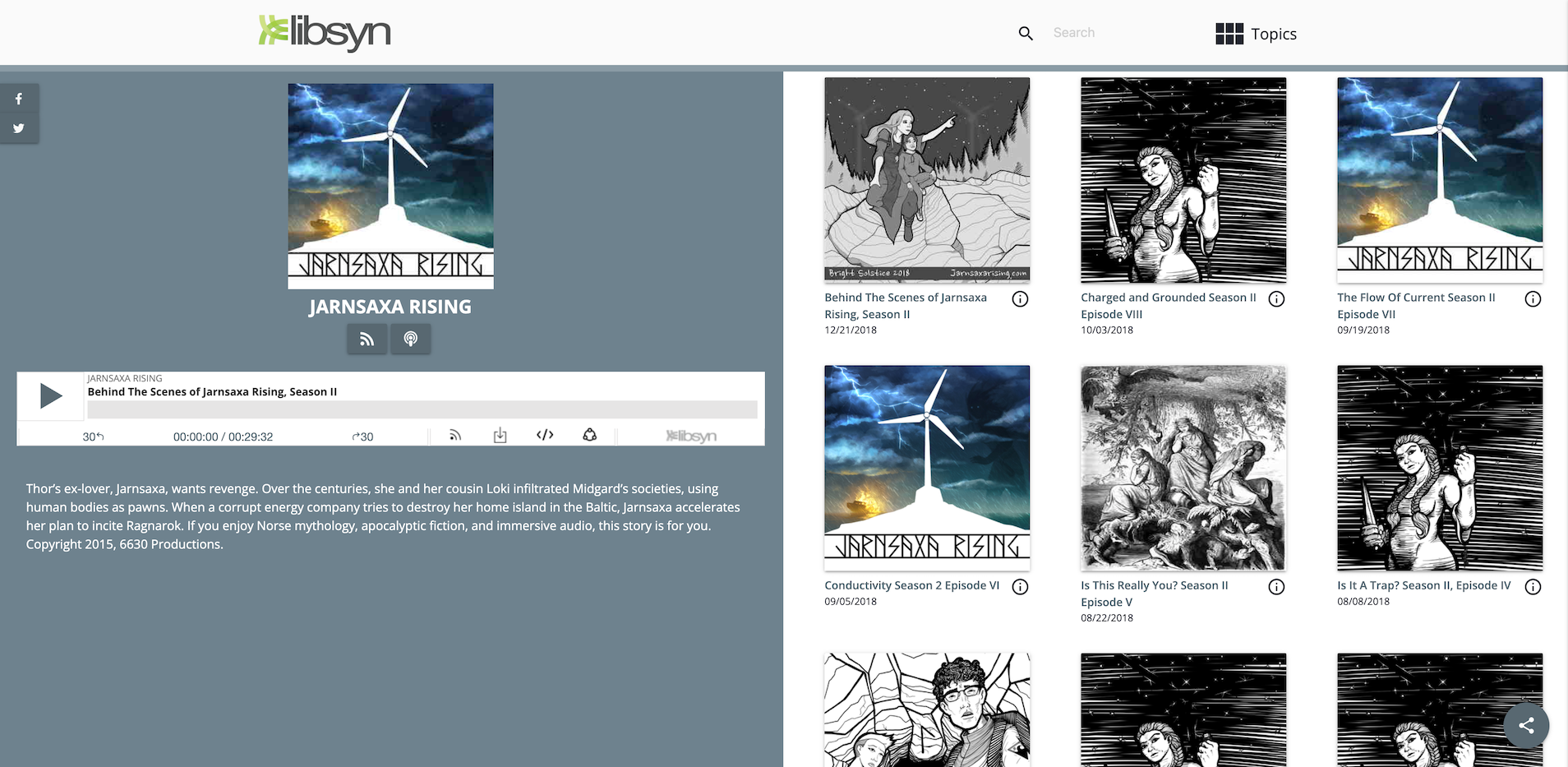
What did I have to do to make this happen? Upload the podcast and cover art, and choose colors and fonts. Piece of cake. But it's not the only cake in town.
Tools like Podpage can use your podcast’s RSS feed to create a website for you in minutes. Here’s a screenshot of three of the templates Podpage offered when I linked it up to Jarnsaxa Rising.
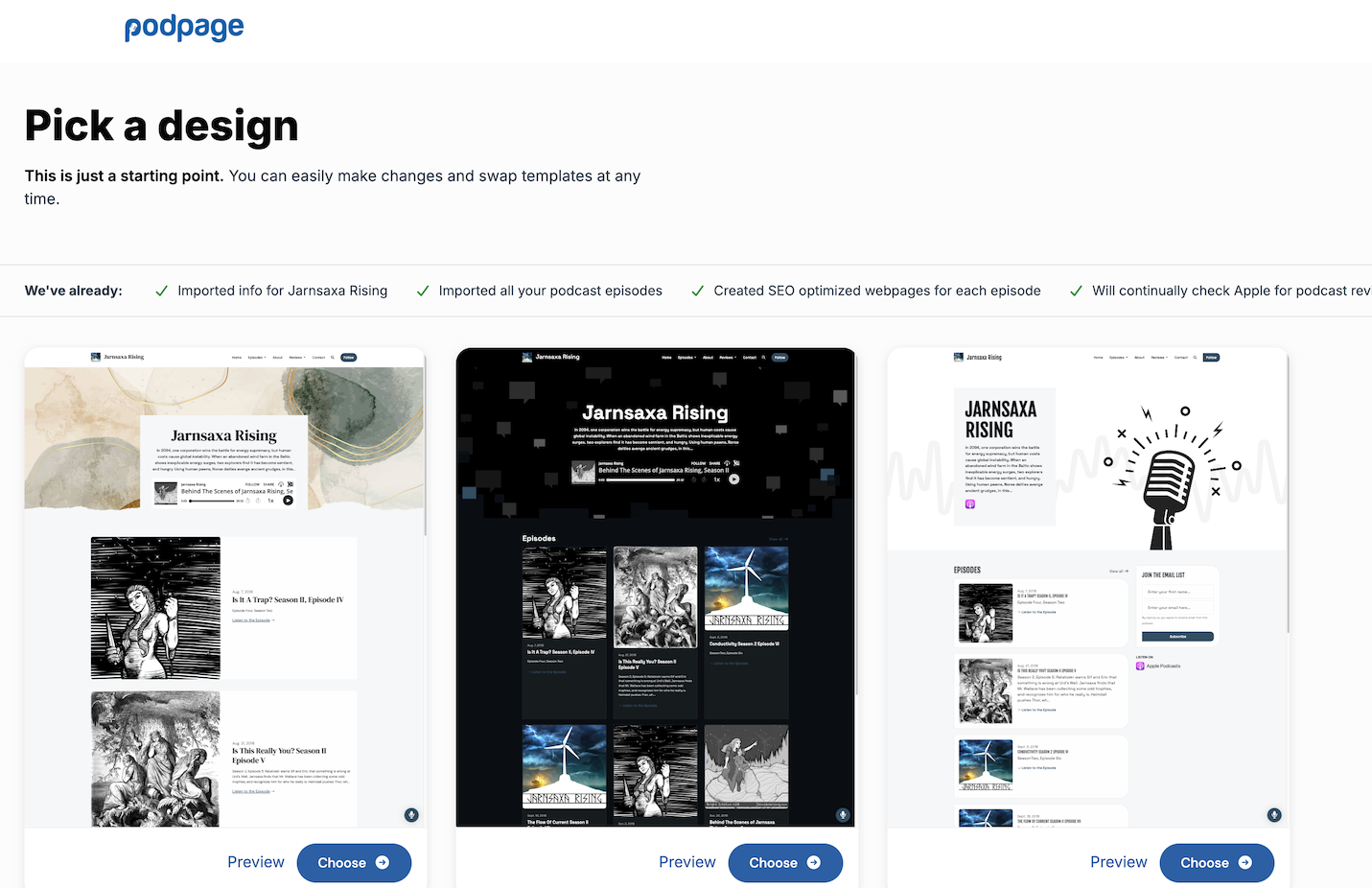
Podpage showed me more than 20 template options. Working with Podpage to make a website is as simple as chatting with a friend. Your episodes, players, and pages update automatically, including Apple Podcasts reviews from your chosen country. Sit down with a tasty beverage and set it up in under five minutes. After that, your podcast website will update itself.
What a Simple Podcast Website Still Does Better Than Any Platform
When you make a podcast website, you have:
- One link you can share anywhere: in your show notes, on business cards, social media handles, merchandise, etc.
- A professional destination to show to potential sponsors, press, interview guests, and audiences
- Stability, no matter how platforms change
- A place for your audience to find transcripts, links to merchandise or crowdfunding options, and to sign up for e-mail updates
- SEO that works in the background to help people find your show
- A single point of contact so listeners don't need to try talking to you via that twitter account you haven't used in five years
- Somewhere to sell products or services, if you monetize your show
What a “Good Enough” Podcast Website Looks Like in 2026
I edit the Fiction Podcast Weekly newsletter. When I learn about a new podcast, I usually receive a link to the episode on a purpose-built site or a podcast hosting service. It’s easy for me to promote the podcast when the podcast website has:
- A “Listen Now” page showing how to find the show in the directory of my choice,
- An “About” page to provide background information,
- A podcast player on the landing page is something most users appreciate.
- Individual episode pages show me episode details, and each episode description supports the podcast’s SEO.
- Contact information is required in case I need to reach the podcaster.
When a podcast website has all of these, not only can I easily promote a podcast in the newsletter, but I’m also more likely to share it with others again because I trust it.
The Real Question Isn’t “Do I Need a Podcast Website?”
You do not need a website to start a podcast. Over time, though, a podcast website becomes the anchor for your work. It is the place audiences return to, collaborators can trust, and supporters can reliably find you.
The good news is that building a podcast website is now straightforward. Most hosting platforms provide a basic site when you launch your show. For example, Podcraft runs on a site generated through Alitu, which can be used as is or connected to a custom domain for easier recall.
If you want something more polished, Podpage can generate a full website directly from your podcast feed in minutes, with no technical setup required. Our Podpage link is an affiliate because it's a tool we use ourselves and are happy to recommend.
A podcast website is not a growth hack or a clever trick. It's ownership. Platforms change, features disappear, and directories shut down. Stitcher is a recent reminder of that. A successful podcast needs stable foundations, and a website provides one.
The real question is not whether your podcast needs a website, but what kind of website it needs to support the work you want to do.
